

Rethinking Placemaking in Bahrain: How Connected Urban Systems Create Long-Term Value
Why connectivity, not just construction, defines lasting urban value

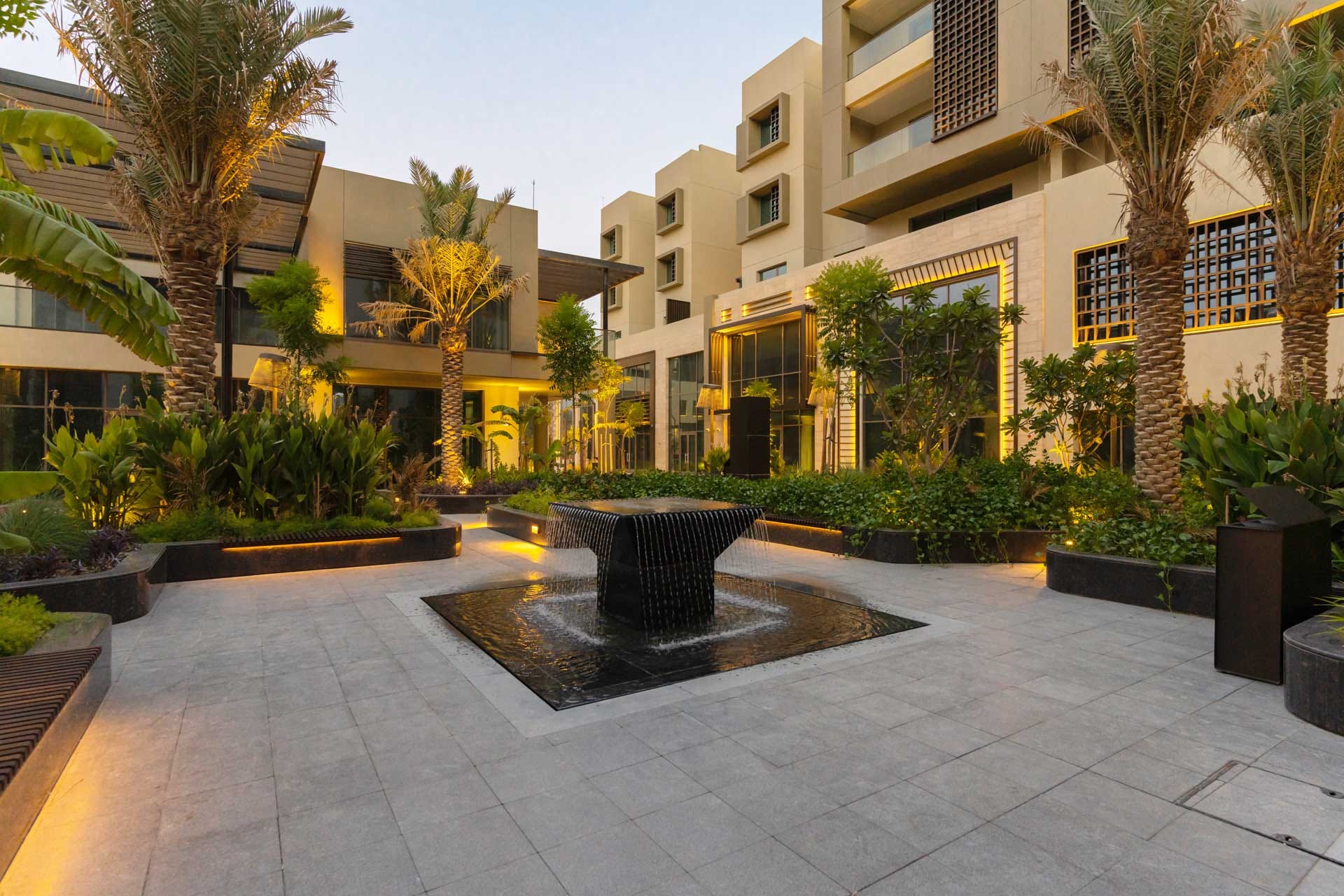
I recently found myself sitting at Joe & The Juice in Liwan, having a smoothie while waiting for my daughter and watching children play in the fountain across from it.
The development comes alive at different times of day and attracts a wide mix of people. Despite being heavily centred around food and beverage - unsurprising in Bahrain, where dining out forms a large part of social life - it still feels varied in how it is used. Mothers meet over breakfast and coffee, families gather after dinner, sixth form students sit with laptops in cafés, and couples meet for casual evenings out.
The landscaped public areas, semi-shaded walkways, and water features make it comfortable to spend time in rather than simply move through. Anchored by a supermarket and a range of thoughtfully designed eateries, it feels less like a collection of restaurants and more like a place people naturally settle into.
What stood out to me was not the architecture alone, or even the individual brands within the development. It was the atmosphere created by layers of everyday life happening at once. The space supported different rhythms of use simultaneously. Some people stayed for hours, while others ran errands or stopped for a quick grocery shop. There was enough comfort, flexibility, and variety for people to inhabit the space in different ways.
To me, this is the essence of placemaking. Not perfection, but creating environments that people genuinely enjoy returning to and spending time in. Liwan is not without its flaws, but it points in a direction that feels increasingly important for Bahrain.
The island is entering a significant phase of development. New waterfronts, mixed-use districts, hospitality concepts, and lifestyle destinations are reshaping the urban landscape quickly. But before discussing activations, events, or design language, it is worth looking at what comes much earlier: the thinking behind what actually makes a place come alive.
Bahrain’s size changes the nature of development entirely. The island is small, development is highly visible, and decisions compound quickly over time. Unlike larger global cities, projects here do not exist in isolation for long.
A development in Bahrain does not simply affect its own site. It influences how surrounding areas are experienced, connected, and valued over time. This creates both opportunity and responsibility.
Bahrain is currently in a period of accelerated growth. Private sector projects are expanding across the island, many with strong ambition and clear commercial logic. Individually, many of these developments may function successfully in the short term. But their long-term value becomes far greater when they are conceived in relation to surrounding districts, public life, movement patterns, and future urban growth.
In larger metropolitan environments, developments can operate with greater separation from one another. In Bahrain, proximity removes much of that distance. What is built in one location immediately shapes the perception and experience of adjacent areas. This changes the role of development entirely.
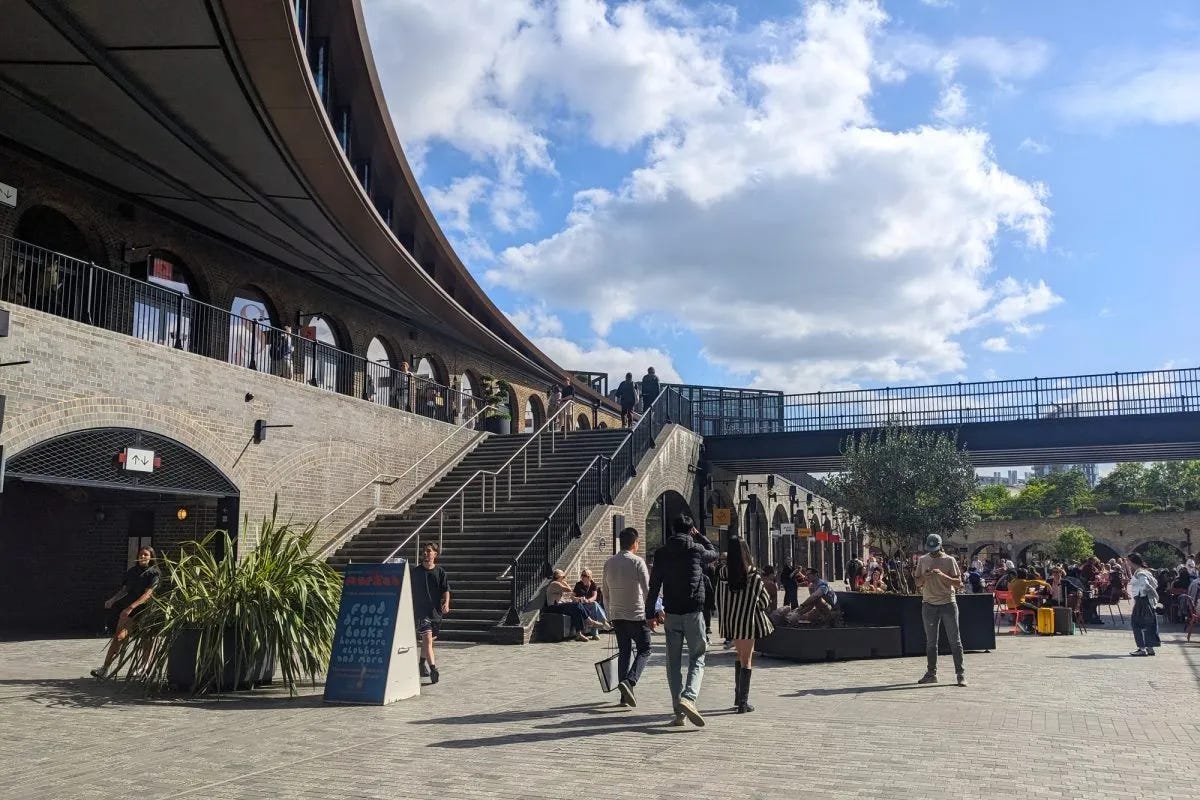
King’s Cross, London offers a useful reference point for how long-term placemaking unfolds over time rather than through a single moment of delivery.
The development did not emerge all at once. It was structured as a sequence of phases, each building on the last:
Early planning (1996-2008) focused on vision and land transformation
Infrastructure and public realm formation followed (2007-2012)
Early activation began with Granary Square and Central Saint Martins (2012-2014)
Mixed-use consolidation took place over the following years (2015-2021)
The district today operates as a continuous urban environment rather than a destination (2022-present)
What is important here is not the timeline itself, but the logic: public realm and daily life were introduced early, not at the end.
Several anchors played a defining role in shaping this outcome:
Granary Square created one of London’s most active public spaces, designed for everyday use rather than programmed events alone.
Central Saint Martins introduced a constant student population that gave the district daily rhythm from the outset.
Coal Drops Yard reinterpreted historic industrial infrastructure into an active urban street, rather than a conventional retail environment.
The canalside network tied movement, leisure, and commuting into a single continuous experience.
Over time, the district developed through a combination of:
mixed-use density
curated tenant mix
public realm-first planning
integration with London’s creative economy
Today, King’s Cross is less a “development” and more a functioning piece of city.
Its evolution continues not through expansion alone, but through long-term stewardship - adjusting uses, refining tenants, and maintaining relevance as patterns of life change.
A project is no longer only a financial or architectural output - it becomes part of the wider experience of the island itself.
And because land is limited, the consequences of poor spatial decisions are difficult to absorb elsewhere. They become visible quickly. On the other hand, well-considered developments do more than succeed individually. They improve surrounding areas, elevate expectations for quality, and contribute to a better everyday experience of the city.
This is why placemaking carries unusual importance in Bahrain compared to many other regional contexts.
“The scale of a place determines the scale of its consequences.”
In Bahrain, the scale of development is closely tied to visible impact.
Projects are experienced directly and repeatedly, and their influence rarely stays contained within a single boundary. Over time, they shape movement, behaviour, and even how entire districts are perceived.
A disconnected waterfront, an inward-facing mixed-use project, or a redevelopment that interrupts the existing rhythm of an area does not remain isolated. It gradually changes how surrounding spaces function and feel.
This is why early decisions matter so much. Not just architectural ones, but structural ones - how districts connect, how people move between them, and how public life is supported across them.
In practice, the real value of a development is rarely contained within its boundary. It is created through connectivity, contribution, and how well it strengthens the wider urban experience.
Even landscape decisions carry this weight. In Bahrain, greenery is not just aesthetic. It is infrastructure - tied to water use, maintenance systems, and long-term operational cost. What looks like a design choice is often a long-term city commitment.
“Cities work best when they are understood as connected systems, not isolated objects.”
A large proportion of development in Bahrain is still approached as a collection of individual assets.
Internally, many projects are highly considered - their mix of uses, architectural identity, sequencing, and commercial model are often carefully resolved. This is natural. Developers are building projects that need to succeed on their own terms.
But on an island of this scale, the line between a project’s internal success and the city’s overall experience is much thinner than it appears.
The question is no longer only whether a project works independently. It is how much more value it could create if it were designed as part of a wider system.
When connections are weak, fragmentation becomes the outcome. People move into defined destinations and leave again, while the spaces in between - which could support everyday urban life - remain underused. Over time, this produces a city of destinations rather than a continuous lived environment. This is where planning becomes critical.
Zoning is not just technical. It quietly determines whether a city functions as a connected fabric or a set of isolated plots. It shapes density, walkability, adjacency, and how districts evolve.
In Bahrain, zoning is effectively cultural infrastructure. It decides whether places reinforce each other or drift apart. But even the best structure is not enough on its own.
This is where taste becomes important. Not as style, but as judgement - about proportion, restraint, material quality, and how things sit together. Because even well-zoned cities can fail if what is built lacks coherence. They become technically efficient but emotionally disconnected.
And in fast-moving environments like Bahrain, that disconnect compounds quickly.
Parks as Communal Infrastructure
Within this wider system, parks are often misunderstood.
They are frequently treated as visual relief within developments - landscaped pauses between buildings. But their real role is behavioural, not decorative.
The strongest parks function as shared civic infrastructure.
They support:
unstructured time
overlapping daily routines
informal social interaction
repeated, habitual use
The difference is simple but important.
Some parks are destinations. Others are part of daily life.
The distinction is not about design quality alone - it is about how deeply they are integrated into surrounding movement patterns.
Projects like Bryant Park in New York show this clearly. Its success is not just in landscape design, but its integration into office, retail, and transport networks that keep it active throughout the day.
When parks are disconnected, they become episodic - used at certain times, empty at others. When integrated properly, they become continuous - supporting life without needing constant programming.
In Bahrain, this matters even more. Climate already limits outdoor use for parts of the year. So public spaces cannot rely on ideal conditions or scheduled activation. They need to function as part of everyday urban structure.
A park that only works occasionally is not a civic space. It is a feature.
“What gives a place value is often what already existed there.”
Alongside new development, another important question is emerging in Bahrain: how does growth integrate with places that already hold identity, memory, and established ways of life?
Some of the island’s most valuable urban environments are rooted in existing areas such as old Muharraq, the historic neighbourhoods around Manama Souq, long-standing commercial streets, and communities that have evolved gradually over time.
In several cases, this has been approached thoughtfully. Initiatives such as the Pearling Path and the restoration of Muharraq’s heritage districts demonstrate how preservation, adaptive reuse, and contemporary activity can coexist in ways that reinforce identity rather than erase it. There is something particularly meaningful about encountering restored family homes, cultural spaces, and small museums woven directly into the dense fabric of the souq and surrounding residential streets. It creates a more intimate relationship between heritage and everyday life rather than separating culture into isolated landmarks.
At the same time, for these efforts to reach their full potential, they need to be supported by a broader long-term vision; one that strengthens the public realm, encourages creative and commercial activity, supports local businesses and artisans, and allows the wider cultural and design ecosystem to become economically sustainable over time.
Internationally, although in a very different context, projects such as King’s Cross demonstrate a similar principle. What was once an underused industrial area evolved into a mixed-use district through long-term planning, adaptive reuse, strong public realm design, and integration into the wider city fabric rather than isolated redevelopment.
What often determines the long-term success of these environments, however, is not only the quality of individual projects. It is the planning framework surrounding them. Zoning plays a decisive role - not only in shaping buildings, but in managing long-term urban pressure. Height limits, land-use transitions, and density controls influence whether character survives at street level or is gradually diluted through incremental change.
Oman offers an interesting regional example of this. Its long-standing approach to limiting building heights in many areas has helped preserve a more human scale and visual continuity across its cities. Whether one agrees with every aspect of the policy or not, it demonstrates how planning decisions made early can strongly shape the long-term identity and experience of a place.
In Bahrain, where development is accelerating quickly and land is limited, these decisions become even more consequential over time.
At the same time, new development is not inherently in conflict with the existing urban fabric. Larger contemporary projects can contribute positively when they are carefully calibrated in scale, materiality, and engagement with the public realm.
When approached thoughtfully, new development can create continuity - allowing areas to evolve without losing the qualities that made them meaningful in the first place.
What is often most vulnerable is not the architecture itself, but the everyday life surrounding it: small independent businesses, informal gathering spaces, familiar rhythms of movement, and the social interactions that give a place its character and sense of belonging.
This is ultimately an argument for continuity. A fundamental question remains:
Who is this place for once it is complete?
What forms of everyday life are being sustained?
And how does the existing community remain part of that evolution? These are not limitations to growth. They are what allow a place to retain meaning as it evolves.
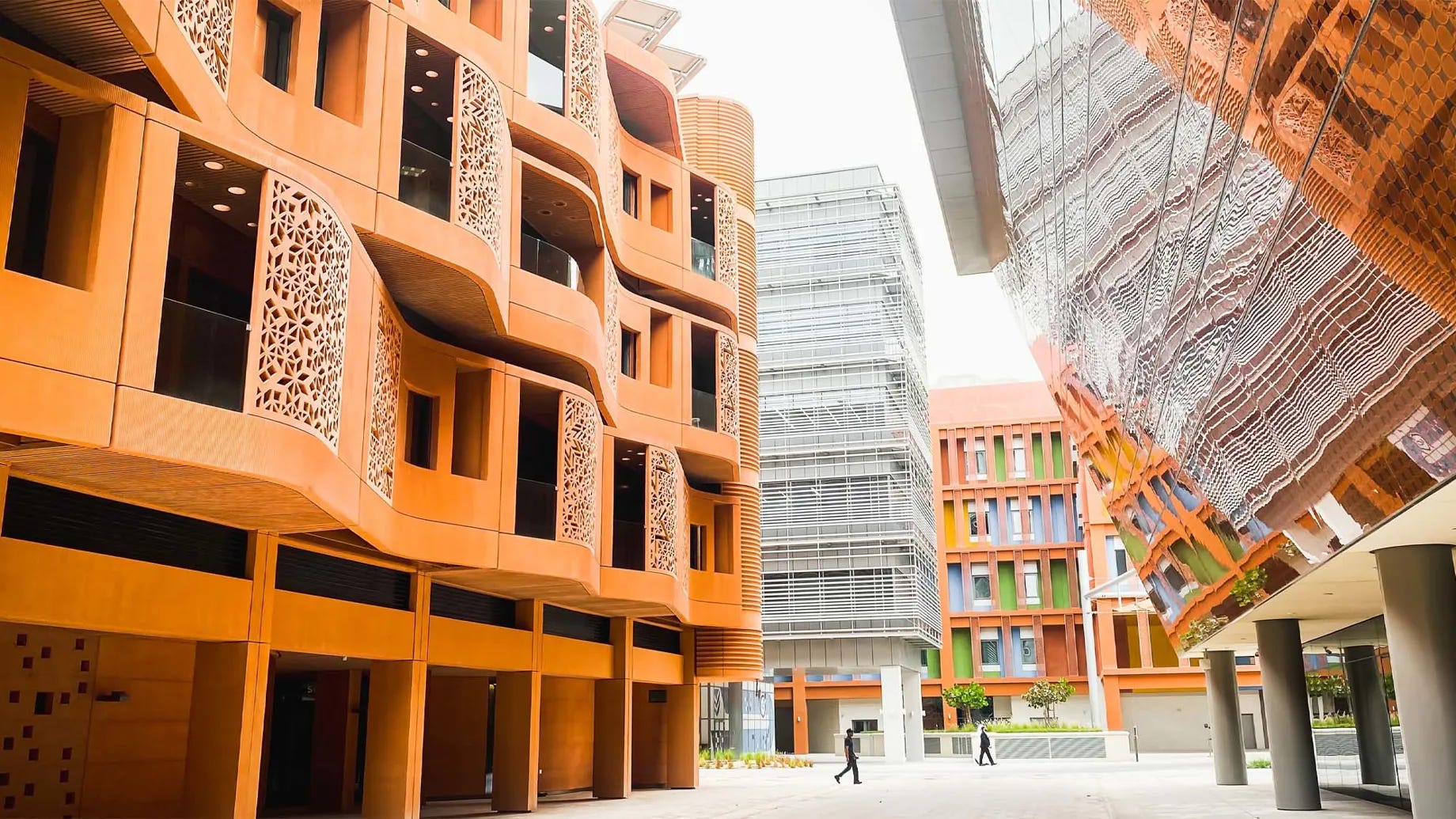
“Climate is not an amenity. It is a condition.”
In Bahrain, no placemaking strategy is credible if it does not begin with climate reality.
For much of the year, heat is not simply a design consideration - it is a functional constraint. Public spaces that do not respond to this condition become difficult to use for large parts of the year.
This fundamentally changes design priorities.
Shade is not an amenity - it is essential infrastructure.
Walkability depends on thermal comfort.
Material choices directly affect whether people remain in a space or avoid it.
Landscaping must respond to long-term water and maintenance realities.
Public realm design becomes as much about environmental performance as visual composition.
Some contemporary projects, such as Masdar City, demonstrate system-level responses to heat through shading strategies, reduced exposure, and integrated energy systems. Traditional urban environments in hot climates solved similar problems long before sustainability became a formal discipline, using compact streets, density, natural shading, and thermal mass to reduce heat exposure.
More recent projects, such as Bilaj Al Jazayer, reflect a growing understanding that climate-responsive design needs to be embedded from the outset rather than added later.
Alongside thermal comfort, resource efficiency is becoming a structural requirement.
Increasingly, developments need to account for:
water scarcity
energy demand
long-term operating costs
durability and maintenance
lifecycle performance of materials and systems
Integrated infrastructure, such as greywater reuse, district cooling, and solar energy generation, is quickly moving from ‘innovative additions’ to expected baseline systems.
International examples such as Hammarby Sjöstad demonstrate how environmental systems can be integrated directly into masterplanning rather than layered onto projects after completion.
Equally important is the distinction between appearance and performance. In hot, dry climates, highly irrigated “green” landscapes often carry significant hidden resource costs. What appears visually lush can become operationally intensive and environmentally inefficient over time.
Sustainability, in this context, is not about creating the image of nature. It is about aligning design with climatic reality, resource constraints, and long-term usability.
“The most important decisions are made before design begins.”
By the time a project reaches design development, many of the most important decisions have already been made - land use, scale, access, circulation, and financial structure.
But the decisions that often determine whether a place genuinely succeeds happen even earlier.
What is this place actually for?
Who is it serving on an ordinary Tuesday afternoon, not just during launch season or weekend peaks?
And how does it fit into the wider life of the city around it?
These questions shape whether a development becomes part of everyday urban life or remains a destination people visit briefly before leaving.
The strongest projects are designed around real human behaviour and daily rhythms. They work for morning coffee meetings, school pickups, casual evening walks, errands, remote work, and spontaneous social interaction - not only programmed events or high-traffic weekends.
When this level of thinking happens early, projects tend to perform very differently over time. Activity becomes more natural and consistent. People return more frequently. Tenants benefit from steadier footfall rather than depending heavily on constant activation and marketing. When it does not happen, the opposite often becomes visible fairly quickly. Spaces can look impressive initially but struggle to sustain energy beyond peak hours. Public areas feel empty outside weekends, tenants rotate frequently, and developments become overly dependent on events to generate life that should have emerged organically through everyday use.
The difference is rarely just architectural, but whether the project is designed around how people actually live.
“Places are remembered not for how they looked, but for how they worked.”
In Bahrain, mixed-use development is gradually expanding the range of everyday environments beyond malls, private clubs, and residential compounds.
This shift matters because it broadens how public life is experienced and how people spend time outside of structured settings.
Developments such as Harbour Row show how combining dining, leisure, and waterfront access within one environment can support both planned visits and informal, everyday use. These kinds of places work because they are used in different ways throughout the day, not because of a single defining feature.
Over time, their value is not defined by individual components, but by how consistently they support repeat use and everyday behaviour.
So what actually makes a place work?
Across different contexts, the most resilient places operate as systems rather than standalone objects.
Their strength comes from how different layers work together over time - social activity, climate response, accessibility, flexibility, comfort, and long-term care.
A good place is not only a visual outcome. It is shaped by how people naturally move through it, spend time in it, and return to it.
In Bahrain, this becomes especially important. Land is limited, summers are intense, and development decisions have long-term consequences.
As a result, placemaking is not just about appearance. It becomes a framework for how urban life is supported over time.
What Makes a Good Place
A good place is not simply a visual outcome or an aesthetic layer. It is a living system shaped by human behaviour, climate, movement, memory, and long-term care.
A single landmark or attraction rarely defines the most successful places. Their strength comes from how multiple systems work together over time: social life, comfort, accessibility, flexibility, ecology, and stewardship.
In Bahrain, where land is limited, summers are very hot, and development decisions compound quickly - these principles become even more important.
1. Places Need Multiple Reasons to Exist
The strongest places function as community magnets rather than single-use destinations.
This is the principle behind the ‘Power of Ten’ framework developed by Project for Public Spaces: successful places create layered experiences that give people multiple reasons to arrive, stay, and return.
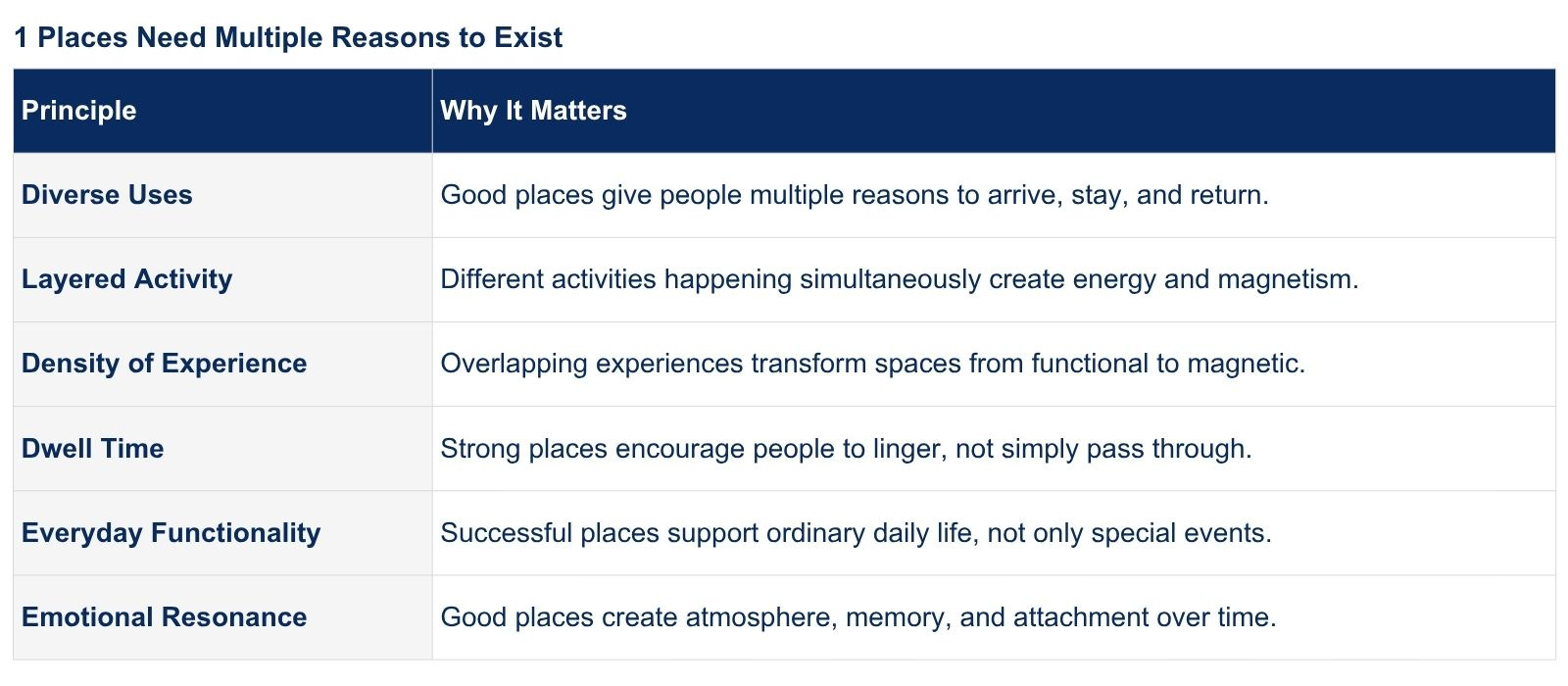
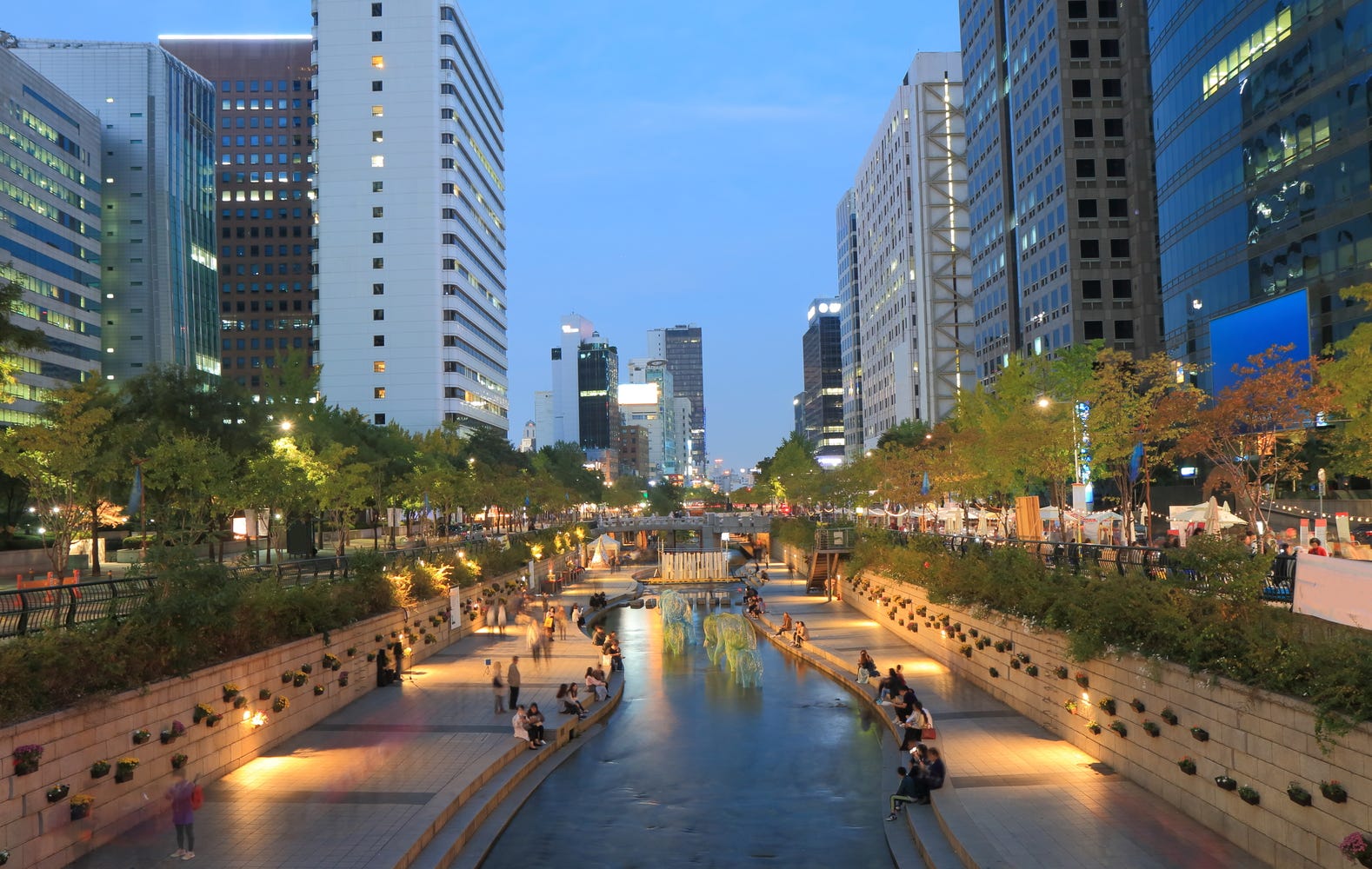
Projects such as Bryant Park succeed because they support many rhythms of life simultaneously: eating, reading, gathering, resting, observing, and social interaction across different times of day.
2. Places Must Connect Into Daily Life
A successful place behaves like part of a larger urban system rather than an isolated object. Especially in Bahrain, disconnected developments can quickly fragment the experience of the island.
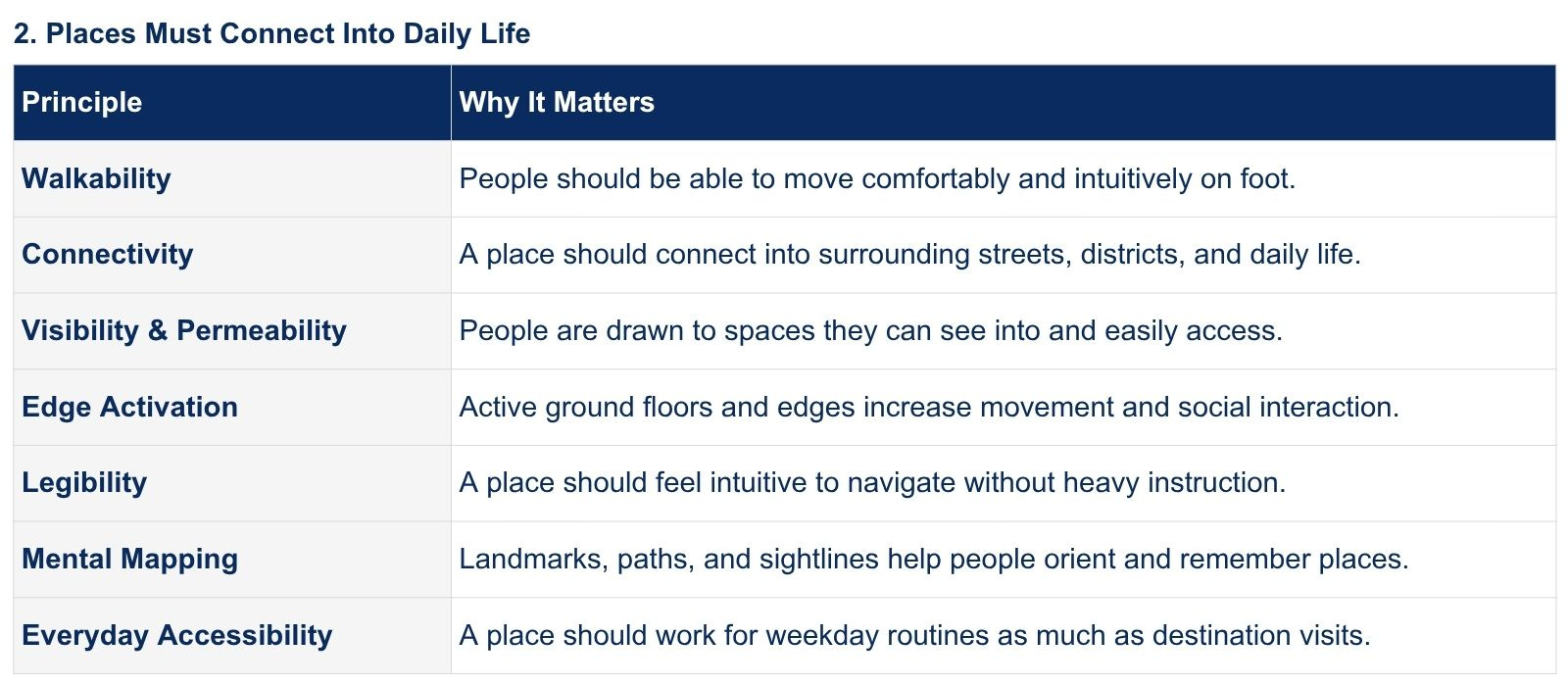
Projects such as Cheonggyecheon demonstrate how reconnecting fragmented urban systems can dramatically improve public life, ecological performance, and pedestrian activity simultaneously.
3. Climate Comfort Is Not Optional
In hot climates, comfort determines whether public space functions at all. Shade, airflow, cooling, material temperature, and microclimate are not aesthetic enhancements. They are baseline infrastructure.
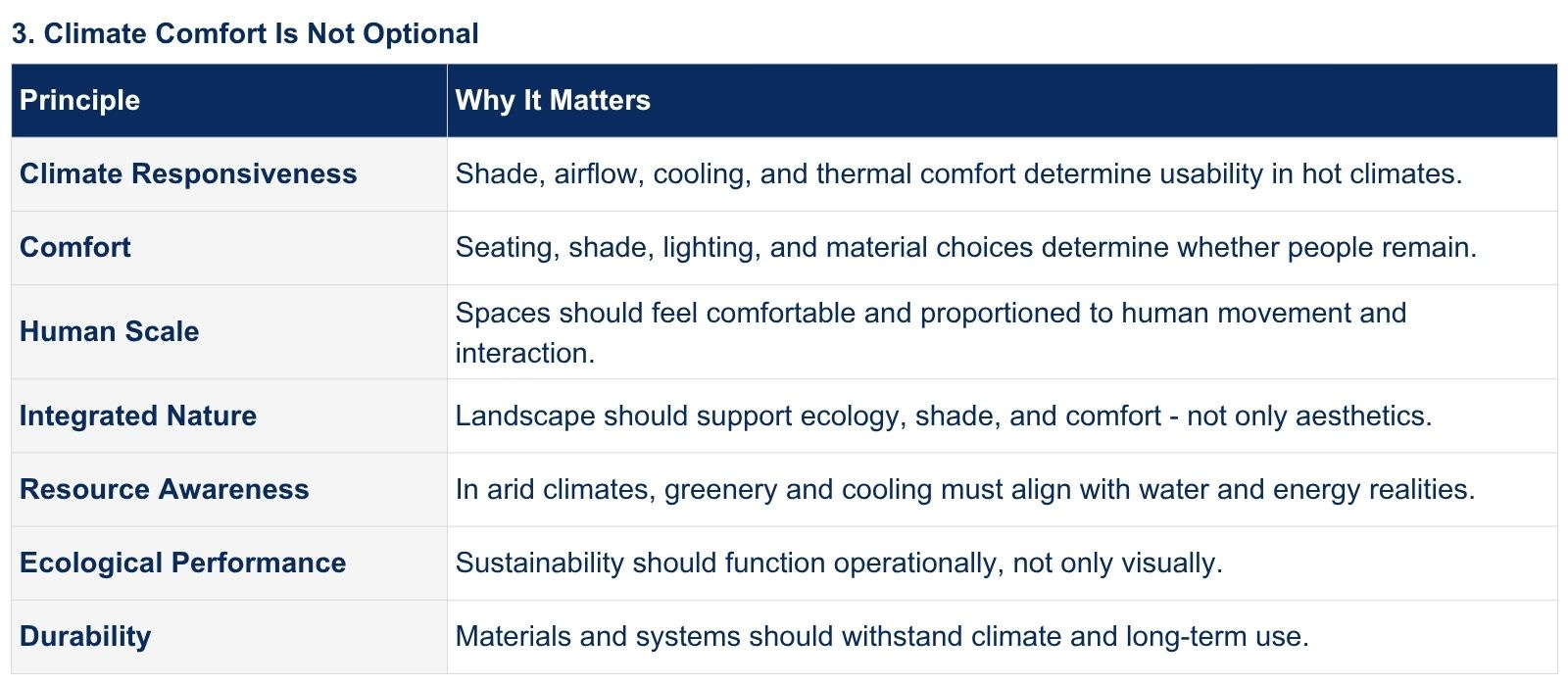
Projects such as Masdar City and Al Bahar Towers demonstrate how climate-responsive systems can be integrated directly into architecture and urban form rather than added cosmetically afterward.
Increasingly, the challenge for Bahrain is not simply creating greener environments, but creating landscapes and public spaces that remain climatically, ecologically, and economically sustainable over time.
4. Good Places Feel Socially Alive
People return to places where they sense life unfolding around them. Successful public environments support interaction, visibility, coexistence, and shared rhythms of daily life.
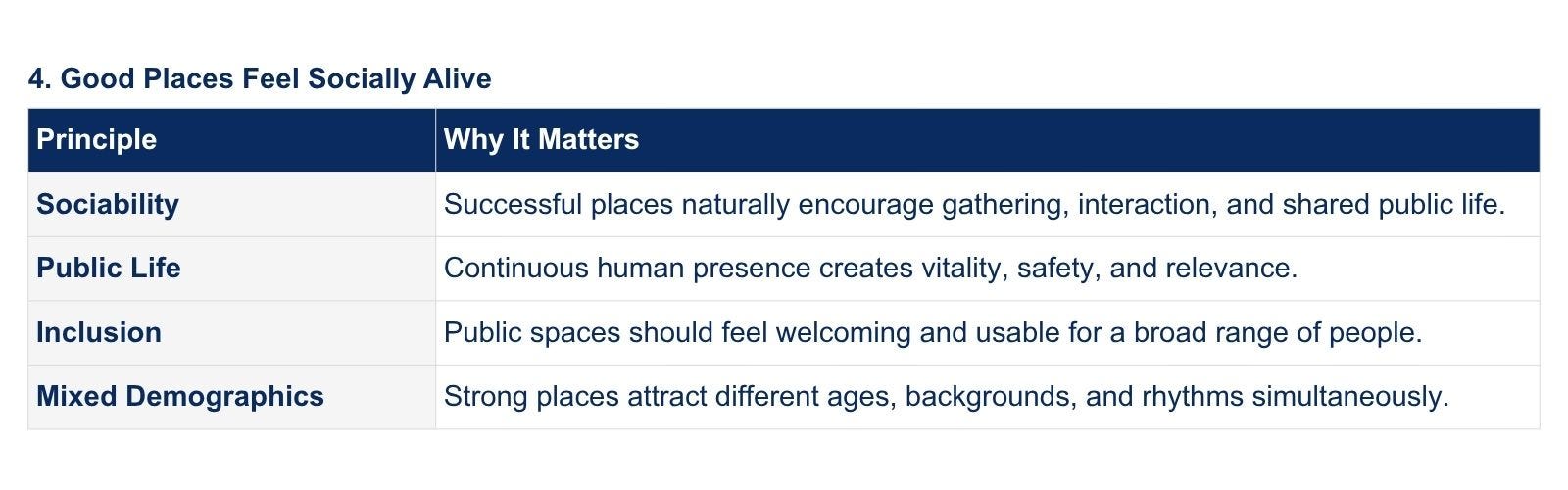
Projects such as The High Line succeed not only because of design quality, but because they support continuous human occupation across different demographics and times of day.
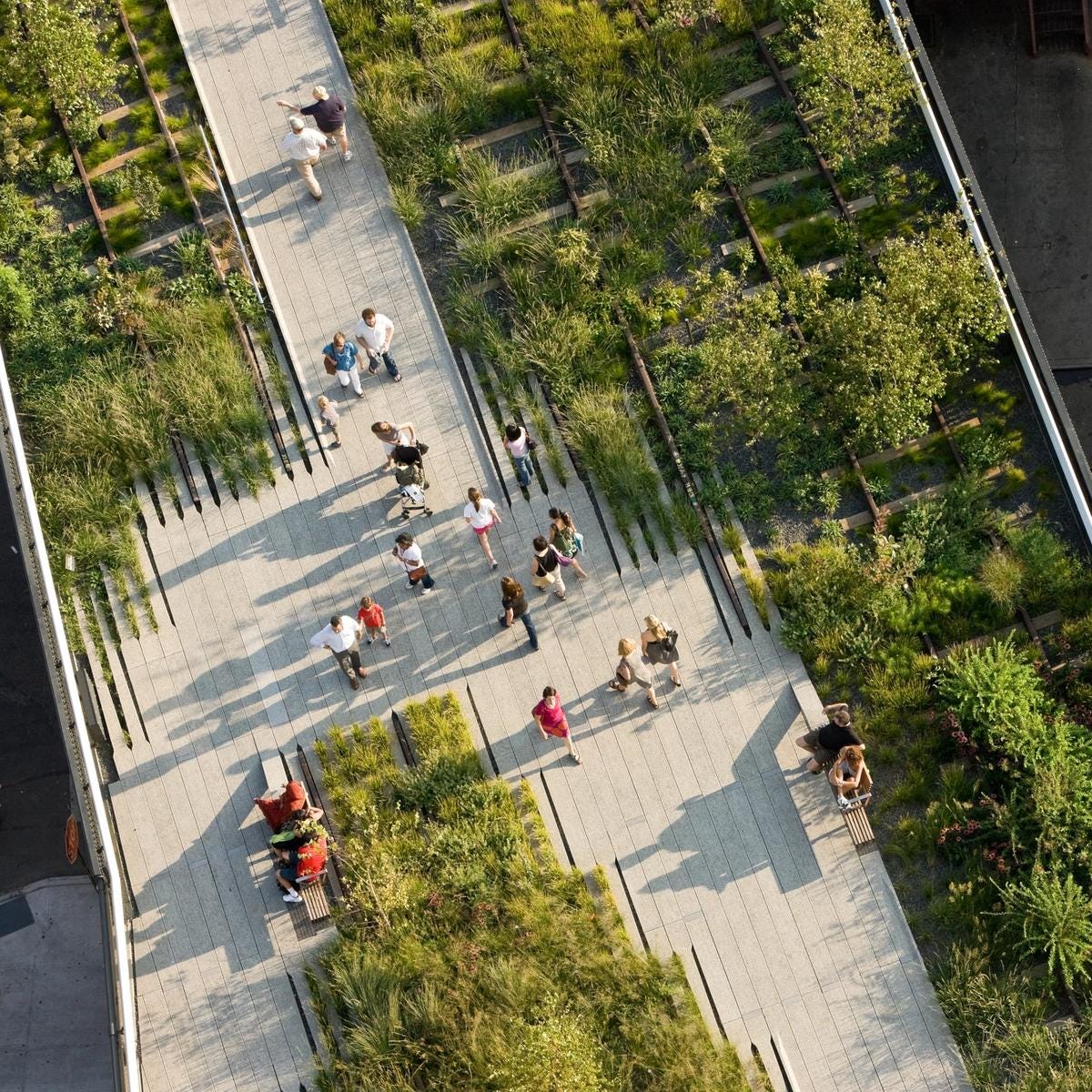
5. The Best Places Leave Room for People
Over-designed places often become rigid. The most successful environments allow for flexibility, interpretation, and human adaptation over time.
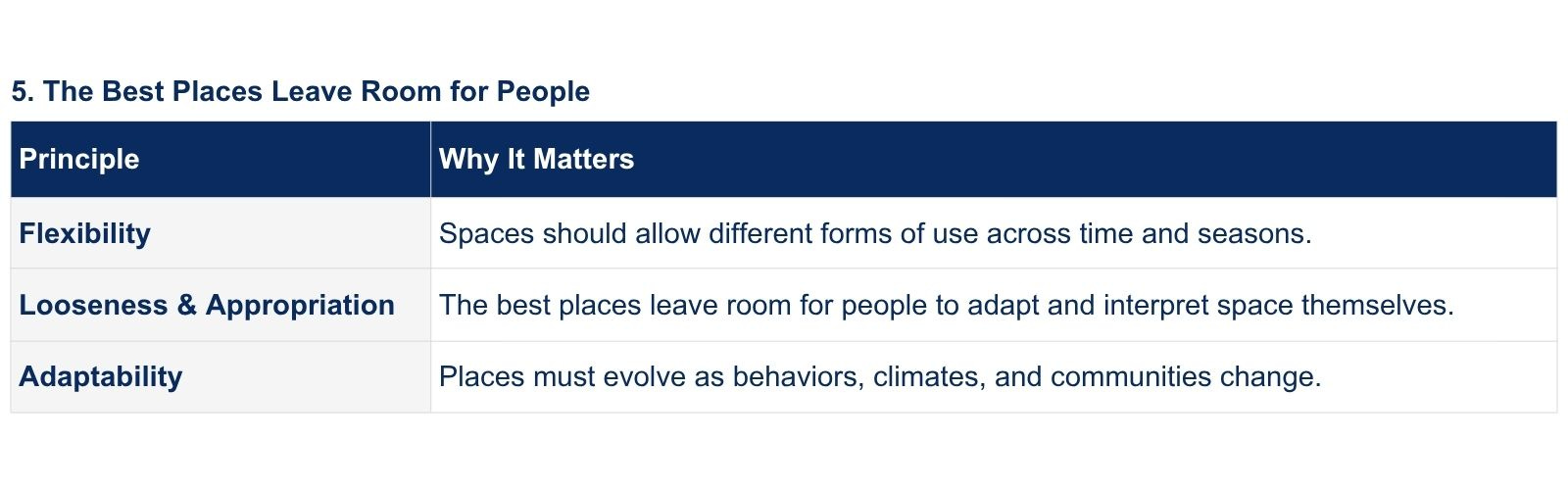
The most loved public spaces are often the ones that feel slightly unfinished in the best possible way: open enough for people to shape them through everyday use.
Piazza del Campo in Siena is a historic civic square that functions as a flexible urban stage. It has no fixed programming, yet it constantly adapts: markets, gatherings, festivals, everyday sitting, and the famous Palio horse race all reshape its meaning over time.
6. Places Require Stewardship Long After Opening
A place is not finished at launch. Its long-term success depends on continuous management, adaptation, maintenance, and observation.
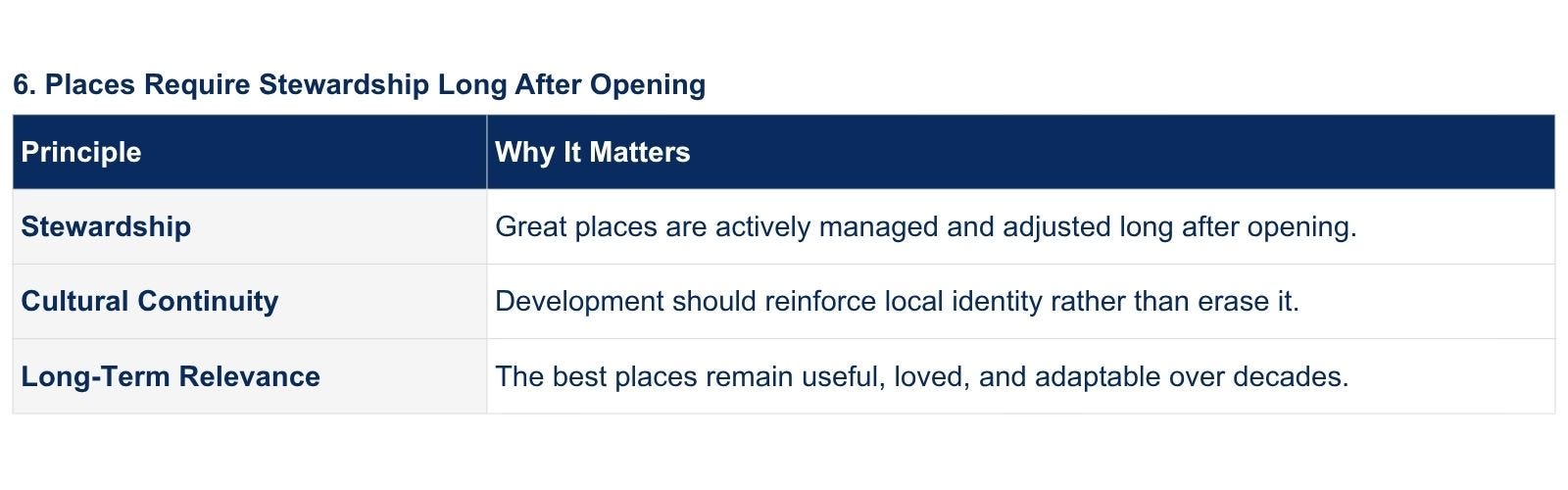
Projects such as King's Cross Development demonstrate how successful districts evolve through long-term stewardship rather than static delivery. What works in year one may not work in year ten. The strongest places continue listening, adapting, and evolving alongside the communities that inhabit them.
7. Taste Is an Infrastructural Condition
In highly visible, fast-developing contexts like Bahrain, the quality of design is not just aesthetic - it directly shapes perception, value, and trust.
Taste determines whether a place feels considered or careless, coherent or fragmented. Over time, this compounds into how entire districts and cities are read.
Good design is not about style. It is about clarity, restraint, material intelligence, and coherence across systems.
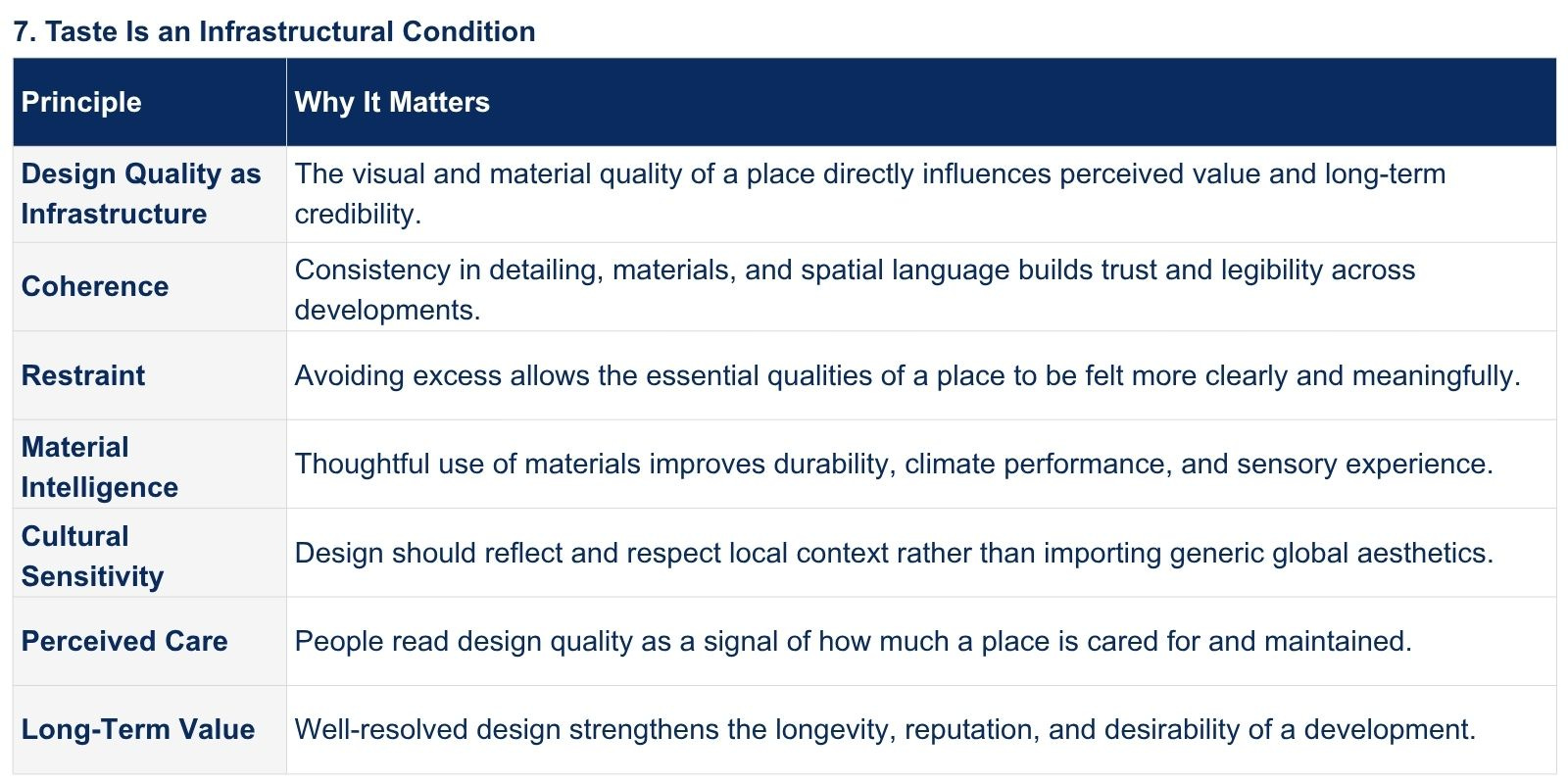
Again, using the King’s Cross example, it demonstrates how consistent design governance and material discipline across multiple stakeholders can create a coherent district identity over time, rather than a fragmented collection of individual buildings.
In this sense, taste is not subjective decoration - it is a systemic layer of placemaking that shapes how everything else is understood.
Why This Matters Now
Bahrain is at a point where the decisions being made today will meaningfully shape how the island feels to live in over the next decade. This creates both opportunity and responsibility.
The next phase of growth will not be defined by the number of projects delivered, but by the quality of thinking behind them.
Across the region, there is already a shift away from isolated, image-led developments toward places that are more connected, climate-aware, and grounded in everyday life.
In Bahrain, this shift carries even greater weight. Because here, everything is close enough to affect everything else. Within this context, placemaking cannot sit at the end of the process. It needs to shape decisions from the start - how places connect, how they respond to climate, how they support daily life, and how they evolve.
At DECORUM, this is the direction we believe matters most: moving from standalone developments to connected places that people actually want to return to and be part of. Because the most enduring environments are not the most visually striking at first glance - but the ones that quietly earn trust over time.
Spaces with soul come from restraint, clarity, and care - and from a simple understanding that good placemaking is ultimately about improving quality of life.
This is the opportunity emerging in Bahrain. And it is one worth getting right.